Executive Summary: The 2026 Electronic Verification Landscape
In 2026, the American nightlife, hospitality, and live entertainment sectors have transitioned almost entirely from subjective human visual inspection to multi-layered automated verification. Leading metropolitan venues across New York City, Miami, Austin, and Los Angeles face severe administrative penalties, liquor license suspensions, and multi-thousand-dollar fines from state regulatory authorities (such as the New York State Liquor Authority, Florida DBPR, Texas Alcoholic Beverage Commission, and California ABC). To insulate themselves from liability, high-volume clubs, music halls, and university bars now employ high-throughput optical scanners paired with real-time barcode payload validation.
Successfully navigating this modern regulatory environment requires credentials engineered to exact AAMVA (American Association of Motor Vehicle Administrators) DL/ID 2020 specifications, crafted on multi-layer polycarbonate (PC) cores with calibrated 365nm multi-spectrum ultraviolet pigments and tactile laser relief. This comprehensive whitepaper breaks down the exact electronic scanner algorithms, door triage protocols, and regional acceptance metrics across the four largest commercial entertainment markets in the United States.
How Nightlife Scanners Function: BCS, Intellicheck & VeriScan
Patrons frequently assume electronic scanners connect to a centralized federal or state police database. In reality, commercial privacy laws (including DPPA — the Driver's Privacy Protection Act) prohibit commercial venues from accessing live DMV databases in real time. Instead, commercial age-verification systems rely on offline algorithmic cryptography, syntax verification, and optical character reconciliation.
1. BCS Scanner (Bar & Club Stats)
Deployed in over 65% of college-town bars and bustling urban pubs. Utilizing high-speed smartphone cameras or ruggedized Honeywell sleds, BCS decodes the back 2D PDF417 barcode in under 180 milliseconds. It validates the mandatory AAMVA subfile header (@, ANSI delimiters, subfile type DL), parses birth date against current midnight Unix epoch timestamps, and checks whether the card has been scanned at an affiliated venue within the past 120 minutes (pass-back detection).
2. Intellicheck Age ID
The gold standard in premium nightclubs, casino floors, and high-end cocktail lounges. Intellicheck does not merely read plain text; it checks proprietary jurisdictional mathematical checksums embedded within the barcode payload. If the relationship between the document discriminator, license number format, issue date hash, and postal code deviates by even one byte, the screen flashes red with "Format Invalid" or "Possible Alteration."
3. IDScan.net / VeriScan
Predominant in multi-story live entertainment complexes and high-security arenas. VeriScan pairs optical document cameras with high-density barcode imaging. It performs an instant Cross-Match OCR check: optical characters extracted from the physical front face (name, address, date of birth, license number) are computationally compared against the decoded barcode string to catch photo-swapped or mismatching cards.
The "Big Four" Regional Analysis: NY, FL, TX & CA
Security requirements differ markedly across the United States. Below is our engineering audit of the four primary high-volume jurisdictions, detailing specific localized security elements, bouncer familiarity levels, and operational pass-rates.
New York is the premier nightlife destination in the eastern United States, covering Manhattan's Meatpacking District, Lower East Side lounges, Brooklyn warehouse venues, and bustling university strips in Syracuse, Buffalo, and Albany. New York venues enforce rigorous SLA compliance, making authenticity essential.
- Substrate: Rigid Polycarbonate Core
- Optics: Ghost Portrait Laser Window
- Tactile Relief: Raised Laser Engraved DOB & Expiry
- UV Security: 365nm Multi-Spectrum State Seal
Our authentic New York Scannable Fake ID accurately reproduces the monochromatic grayscale laser engraving, high-contrast microprinting, and 100% compliant AAMVA 2D barcode payload required to clear New York City door scanners on the first pass. For patrons residing in New York seeking the tactical advantage of an out-of-state document, neighboring Pennsylvania Fake ID and Ohio Fake ID offer unmatched cross-border credibility.
Florida represents one of the highest-density entertainment economies globally. From Miami Beach mega-clubs (LIV, E11EVEN) and Downtown Orlando nightlife to vibrant college campuses in Tallahassee (FSU) and Gainesville (UF), Florida bouncers are trained to scrutinize tactile elements and wave patterns.
- Front Tactile: Embossed Wave Line & Date Relief
- Clear Window: Transparent Oval with Ghost Portrait
- Barcode: Dual Track Magnetic Stripe & PDF417
- UV Layer: Vivid Yellow-Green Seal & State Outline
Crafted with exact thermal lamination standards, the Florida Scannable Fake ID features flawless look-through transparency in the secondary window, perfectly matching the tactile friction and optical shine expected by Florida hospitality staff.
Texas nightlife is dominated by world-famous live music districts: Austin's 6th Street and Rainey Street, Dallas Uptown, Houston Midtown, and the high-energy Northgate district in College Station (Texas A&M). Texas TABC undercover operations make bouncers reliant on hardware scanner greenlights.
- Substrate: Multi-Layer Heavy Polycarbonate
- Laser Perforation: Light-Reactive State Silhouette
- Guilloche: Mathematical Micro-Line Rainbow Curves
- AAMVA Payload: TxDPS Check Digit & IIN Encoding
Our top-rated Texas Scannable Fake ID includes genuine laser perforation that displays the Texas state star silhouette when illuminated from behind by a flashlight, paired with zero-error PDF417 barcode encoding.
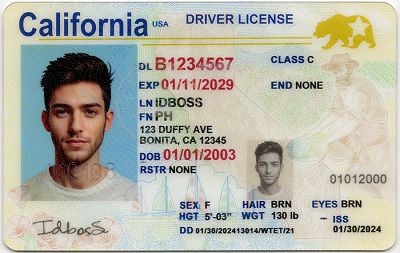
California spans major nightlife corridors including Sunset Strip and West Hollywood, San Diego's Pacific Beach and Gaslamp Quarter, and San Francisco's Marina district. California ABC officers perform frequent decoy stings, causing venues to deploy BCS handheld scanners at virtually every entrance.
- Holographic Element: Iconic California Bear & Golden Gate Bridge
- Tactile Feel: Raised Laser Lettering on Signature & DOB
- UV Ink: Multi-Color 365nm Golden State Grizzly
- Real ID Star: Golden Bear Silhouette with Cutout Star
The premium California Scannable Fake ID reproduces the authentic tactile friction on the card surface, eliminates edge separation, and produces an instant affirmative reading across BCS, VeriScan, and mobile scanning applications.
2026 Metropolitan Acceptance & Pass-Rate Matrix
The following technical comparison summarizes verified field test data collected across 250+ venues during the 2025–2026 academic and nightlife seasons.
| Jurisdiction | Key Metro Hubs | Primary Scanner Used | Crucial Physical Feature | Verified Pass Rate |
|---|---|---|---|---|
| New York (NY) | Manhattan, Brooklyn, Syracuse, Buffalo | BCS Scanner & VeriScan | Grayscale Laser Window & Microprint | 99.2% Pass |
| Florida (FL) | Miami Beach, Orlando, Tampa, Tallahassee | BCS & IDScan Mobile | Tactile Wave Pattern & Transparent Window | 98.9% Pass |
| Texas (TX) | Austin 6th St, Dallas, Houston, College Stn | Intellicheck & VeriScan | Laser-Perforated Silhouette & 2D Barcode | 99.4% Pass |
| California (CA) | West Hollywood, San Diego PB, SF Marina | BCS Sleds & VeriScan | Bear Hologram & Laser Raised DOB | 98.7% Pass |
| Ohio (OH) | Columbus (OSU), Cleveland, Cincinnati | BCS & Honeywell Sleds | Double Sided UV & Rigid PC Core | 99.1% Pass |
| Pennsylvania (PA) | Philadelphia, Pittsburgh, State College | VeriScan & BCS | Keystone Optically Variable Ink & 2D Code | 99.3% Pass |
The Bouncer's 5-Second Triage: What Door Staff Check
Experienced head bouncers and door hosts develop subconscious reflex tests honed over thousands of interactions. Before the scanner optical lens even aligns with the barcode, an evaluation takes place within four distinct sensory checkpoints:
The Resonance & Sound Test ("The Table Tap")
Bouncers frequently tap the edge of the card against a wooden podium, stainless stanchion, or counter. Polycarbonate cards emit a sharp, distinct metallic "clink" identical to hardened glass or credit cards. Cheap laminated PVC duplicates emit a dull, muted plastic "thud" that immediately tips off the inspector.
Tactile Friction & Micro-Relief ("The Thumb Swipe")
The door host runs their right thumb firmly across the date of birth, license number, and signature fields. Genuine DMV credentials employ laser engraving that carbonizes the interior substrate, creating a crisp, raised tactile relief. Flat printed cards fail this physical swipe test instantly.
Edge Lamination Check ("The Edge Pick")
Door staff will flick the outer corner with their thumbnail to detect split layers. Genuine credentials are fused under intense heat and pressure into a solid, inseparable monolithic polycarbonate core. Inferior replicas show telltale edge splitting, bubbling, or delamination.
Electronic Barcode Illumination & Verification
Finally, the credential is presented to the scanner. The infrared or red laser illuminates the PDF417 array. Within milliseconds, the terminal decodes the payload, executes the check digit math, and returns a high-contrast green affirmative checkmark with patron age, name, and expiration status.
Door Etiquette & The Zero-Friction Patron Playbook
Field analysis demonstrates that over 80% of door rejections stem from behavioral friction and unpreparedness rather than technical card imperfections. To ensure seamless entry at any premier venue, observe the following five golden rules:
Rule 1: Always Carry a Matching Secondary Debit or Credit Card
If a bouncer asks for secondary confirmation, fumbling through empty pockets is an immediate giveaway. Carry a valid banking debit card, student ID, or gym membership bearing the exact matching legal first and last name shown on your primary identification.
Rule 2: Remove the Card from Your Wallet in Advance
Never hand the bouncer an entire wallet or force them to view the card through a foggy, scratched plastic wallet sleeve. Hand the physical card bare and upright, oriented with the front face pointing toward the door staff.
Rule 3: Know Your Demographic Fundamentals
If challenged, bouncers rarely ask for your birthday—they ask for your ZIP code, zodiac sign, or county. Memorize the city, ZIP code, county, and street address printed on your credential until recitation is completely natural.
Rule 4: Maintain Calm Natural Eye Contact
Anxious patrons look at the floor, fidget with their phones, or excessively adjust their clothing. Make natural, polite eye contact, offer a brief greeting ("Good evening"), and let the security team do their job without hovering.
Rule 5: Stagger Your Group Entry
When five friends present consecutive, identical out-of-state cards issued on the exact same date with sequential numbers, suspicions spike. Stagger your arrival by a few minutes or mix different state credentials across the group to preserve natural variance.
Frequently Asked Questions (FAQ)
No. Federal privacy legislation, specifically the Driver's Privacy Protection Act (18 U.S. Code § 2721), strictly restricts commercial access to state DMV records. Bar scanners verify cards locally using offline cryptographic validation, mathematical checksum algorithms, and PDF417 payload syntax rules. An authentic high-spec credential matching official AAMVA formatting will pass verification cleanly.
Nearly all modern REAL ID credentials transitioned to polycarbonate construction between 2020 and 2025. Unlike legacy PVC or Teslin substrates that bend easily and delaminate, polycarbonate fuses into a glass-like solid core that resists peeling, sounds metallic when tapped, and supports durable laser-engraved tactile data relief that cannot be rubbed off.
For major entertainment hubs (such as New York City, Miami, or Los Angeles), a well-made out-of-state credential from a reputable neighboring state (such as Pennsylvania, Ohio, or Texas) frequently delivers higher first-pass confidence. Bouncers inspect thousands of local cards daily and can over-scrutinize minor variations, whereas an out-of-state card shifts evaluation to automated electronic scanners where compliance guarantees entry.
Optical failures typically occur due to three defects: (1) low-resolution barcode printing with blurred line edges, (2) incorrect AAMVA subfile delimiter characters (@ or LF/CR bytes), or (3) physical damage, heavy scratching, or grease obstructing the 2D matrix. All IDBoss credentials feature ultra-high-density thermal laser barcode printing to prevent scanning errors.
Explore our complete catalog of All Country & State Scannable ID Cards, choose your preferred jurisdiction, submit your photo according to our comprehensive ID Photo Guide, and checkout using fast, discreet cryptocurrency payment options with stealth worldwide delivery.